Robert Mitchell’s Wartime Sketches of Adam Park - Illustrations to a Missing Chapter
Robert Mitchell spent only a few months in the POW camp of Adam Park in Singapore in 1942. But his diary drawings have now been of enormous help to British battlefield archeologists who found much more than that at Adam Park. Robert Mitchell's precise drawings are among the very few surviving accounts that allowed the researchers to establish the actual layout of the camp.
Jon Cooper, project manager of the Adam Park Project, has very kindly
The Adam Park Project (TAPP) started in 2009 with the aim to assess the potential for battlefield archaeology in Singapore. T he case study was to be the defence of Adam Park by 1st Battalion Cambridgeshire Regiments who held out in the estate for three days against determined assaults by 2nd Battalion 41st Regiment of the IJA.
It soon became evident to the researchers that there was another war time story to be told about the site. Two months after the fighting had finished nearly 3,000 POWs, Australians and British, sent to build the Shinto shrine on the Singapore Island Country Club golf course, were housed in the estate. The project team needed to understand what went on in this period to ensure they could distinguish between artefacts laid down in the fighting and those lost by the POWs but what we discovered proved to be as fascinating a story as that of the fighting.
It appears that the time the POWs spent in this camp was the prelude to the terrible times they were to face on the Thai Burma Railway and in Japan and by those standards it was a relatively comfortable existence. But by understanding what went on in those nine months we can get a better insight into the condition these men were in when they were shipped abroad. It appears to be a missing chapter in the POW story and one remarkably preserved amongst the buildings of this untouched estate.
There are a number of written accounts about life in the camp, but few authors went on to describe the camp layout and location of the amenities. None of them drew a map. Interviews with surviving veterans added valuable detail but their recollections were understandably vague and as one Digger veteran put it ‘all those bleedin’ black and white houses look the same !’
Robert Mitchell's POW drawings prove invaluable
Then an internet search revealed the existence of Robert Mitchell’s artwork which not only provided graphic images of the camp amenities but gave clues as to their location.
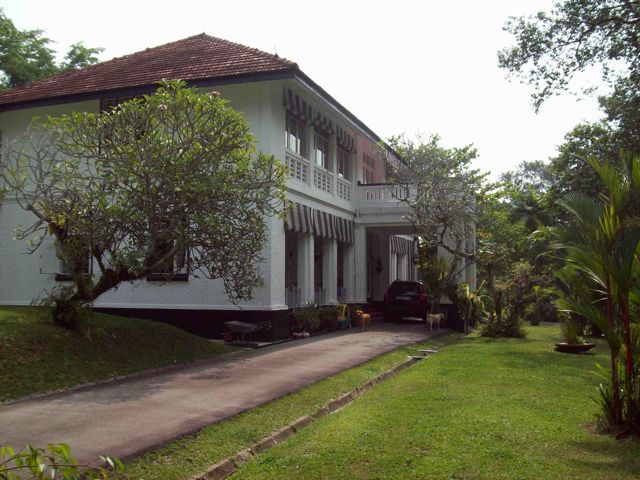
This is house No. 12 today which is not the same as Robert Mitchell's image which is in fact No. 7 Adam Park, but could well be the home of the chapel and canteen in his sketch.
Robert’s image of a bombed out building which he claims housed a chapel and canteen is a good case in point. Not only do we now know what type of house the facilities were in we also know from his sketch of the altar which room it was in and what we could expect to find behind the layers of modern paintwork. However the only problem is that there are five houses on the estate that look like the one Robert drew. If only he had given the house number!
Likewise his images of the Tivoli Theatre, the Memorial Garden, The Japanese HQ and ‘No. 12 Adam Park’ (which is actually No.7 Adam Park) give us tantalising clues as to their location.
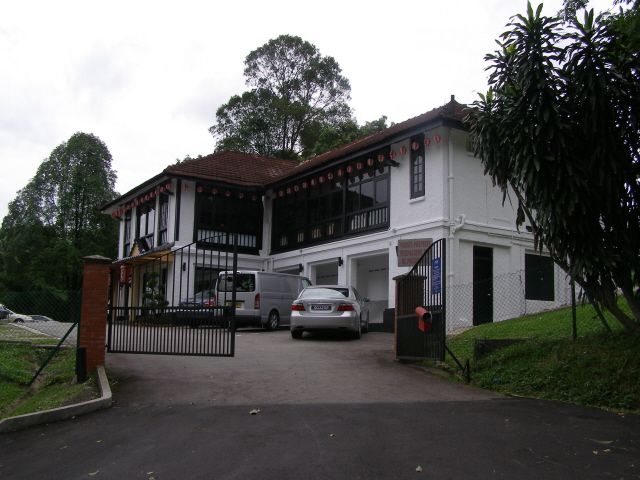
This is No. 7 Adam Park, the Battalion HQ for the Cambridgeshires during the fighting and possibly the hospital for the POWs and the one that Robert Mitchell must have sketched. It is now ironically a Japanese restaurant.
Our research into the camp layout will continue but thanks to Robert’s sketches we are one giant step closer to understanding the workings of this camp and from there we can ensure this part of the POW story is not forgotten.
Robert Mitchell's POW Diaries and Drawings form important part of Academic Art Study
Why and how has art been made at all during difficult circumstances such as war, when surely survival is the first priority? The study 'Analysis of the Functions of the Visual Arts of Japanese Prisoners of War in the Far East during World War II' examines
exactly that, in a dissertation submitted by Verity FitzGerald for the Oxford Brookes BA in History of Art, 2010.
Verity FitzGerald looks specifically at POW camps such as Changi and Kobe during the Second World War,
and has established four main categories: from very personal works to community and commissioned works, as well as historical and medical documents.
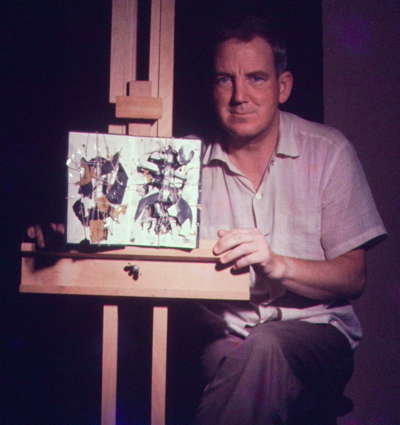
Robert Boyed Mitchell's works make up an important part of this study, exemplifying how art practice can sustain a man in difficult times and surroundings, and influence his later work. You can see examples of Robert Mitchell's drawings during that time in POW Diaries.
It is important to point out that creating art was in most cases very risky, as the Japanese would not allow portrayal of camps, institutions and people. Even possessing writing or drawing materials was risky and had to be well hidden, as the Japanese would severly punish the owners if they found them.
FitzGerald writes on Mitchell's diaries (p. 7): "The collections of Mitchell's POW works appear to take the form of diary entries, with only captions and brief notes to accompany them. This idea of the pictorial diary is typical of therapeutic art as the essence of art therapy is that the artist finds expression in images rather than words. They depict mainly the people and the places around him with a somewhat objective eye, drawing the Japanese guards as he might for any figure study. We see many recordings of the artist's surroundings, from buildings, to goings on, to landscapes. .... His landscapes, although depicting a simple hut or building, are often rich in colour and incorporate the thriving landscape that surround them. Without captions these images reflect modest yet bright and even welcoming set-ups within a picturesque tropical scene, rather than the bleak and disheartening prison life that they led. ..."
She continues: "These works of art are, without a doubt, true documentations and recordings of the life as a Japanese POW, but based on acutely personal intentions behind them they must be read differently to other kinds of documentation. ..... Those works that were created with the purpose of serving as a historical document show a very different style altogether. These private works do not carry a responsibility of accuracy; their only requirement is to be satisfactory to the artist. In most cases, this involves recording the way in which the artist wishes to remember his experiences or by highlighting the more optimistic and favourable features of his captivity."
Another artist that falls into this category is Murray Griffin, one of Australia's Official War Artists at the time. He was captured by the Japanese in 1942 and interned at Changi. There he met Robert Mitchell and taught him to draw in his art classes which he was allowed to hold at the so-called 'University of Changi'.
FitzGerald points out (page 8): "Sketching to pass the time while recovering in Changi was certainly a constructive activity, but not all camps allowed for the time, means and accessibility for this to take place, nor even for these records to be kept. Many of the camps were much stricter on the men and were exceptionally forceful in ensuring that prisoners did not possess anything more than what they were given by the Japanese. Mitchell was perhaps pursuing his risky pastime through a dedication to portraying the beautiful and striking country that he was first met with, wanting to focus his attention on the positive aspects of an otherwise traumatic experience."
On page 9, the author concludes with a view to Robert Mitchell's later art practice: "...The way in which Mitchell learnt to use art as a means of coping with his trying time as a POW was a skill he appeared to have applied well beyond these years. Mitchell's artistic career after the war focused heavily on abstract expressionism for some time, drawing from artists such as Pollock, Picasso and Kandinsky as influences. Mitchell soon began adding new elements to his paintings, with the use of objects like fabric, string and Kleenex tissues he moved towards collage until this became sculpture in its own right. This use of 'found' objects creates a striking allusion to the conditions in which Mitchell first began his artistic journey, where the artist was pushed to make the most of the resources available to him. Although Mitchell's paintings became increasingly abstracted in style, these objects soon took a more literal form of depicting the world around him, by incorporating photographs and fashion images into his paintings he was once again recording elements of the world around him. ..."
Sydney Morning Herald, Spectrum, John McDonald, 2 August 2008: Drawn from the ranks
"There are some historical lessons to be learned from a show at the National Art School Gallery that celebrates the achievements of the Commonwealth Reconstruction Training Scheme at the end of World War II. Lines Of Fire: Armed Services To Art School presents a collection of mostly small, modest works but it brings to life an important period in Australian art and art education.
... Peter Rushforth, Robert Mitchell and Ron Lambert had been prisoners of war and must have seen the irony in spending their postwar years in the old Darlinghurst Gaol, where the school has its campus. Lines Of Fire is one of those poignant shows that reveals another side to well-known artists such as Guy Warren, Tony Tuckson and Robert Klippel and leaves us wondering whatever happened to many of their fellow students who were just as prominent in those days. ...
The students who entered the Commonwealth scheme were hungry for a formal education and determined to get as much out of their courses as possible. Tom Bass, who would dominate Australian public sculpture for more than 20 years, remembers his time at the NAS as "just a wonderful period", and "one of the best things that ever happened to Australia". ..."
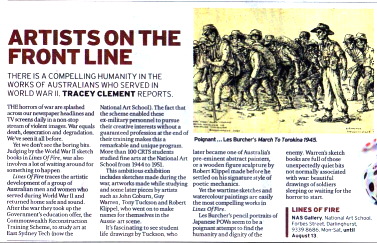
Sydney Morning Herald - Metro, 25 July 2008: Artists on the Front Line
'...Lines of Fire traces the artistic development of a group of Australian men and women who served during World War II and returned home safe and sound. After the war they took up the Government's education offer, ... to study art... This ambitious exhibition includes sketches made during the war, artworks made while studying and some later pieces by artists such as John Coburn, Guy Warren, Tony Tuckson and Robert Klippel..."
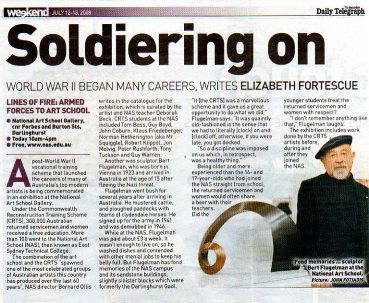
Daily Telegraph, 12 July 2008: Soldiering on - Lines of Fire: Armed Forces to Art School
"A post-World War II vocational training scheme that launched the careers of many of Australia's top modern artists is being commemorated in an exhibition at the National Art School. Under the CRTS, 300,000 Australian returned servicemen and women received a free education. More than 100 went to the National Art School, then known as East Sydney Technical College ...."
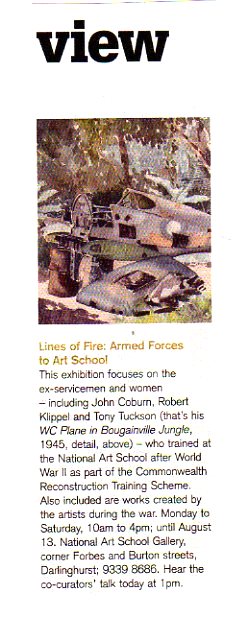
Good Weekend, 12 July 2008: View: Lines of Fire: Armed Forces to Art School
"This exhibition focuses on the ex-servicemen and women - including Joh Coburn, Robert Klippel and Tony Tuckson - who trained at the National Art School after World War II as part of the Commonwealth Reconstruction Training Scheme...."
SBS, World News, 9 July 2008:
Exhibition highlights Soldier Artists
In the aftermath of the Second World War a group of diggers began training at the National Arts School as part of a government scheme to reintegrate soldiers. Many of the students went on to make significant contributions to Australian art. The 'Lines of Fire' exhibition opens at the National Art School tonight and brings together the work of some of the artists during and after the war. Art and war appear to be worlds apart. But for some veterans, drawing helped them through the experience.
GUY WARREN, ARTIST: It keeps you sane. Army life is full of hard work and busy work, and sometimes you're frantic and sometimes you've got nothing to do. There are awful periods of boredom. Most guys played cards. Well, cards always bored the hell out of me, but I drew them playing cards. These Australian diggers weren't just soldiers, they were budding artists. The government's post-war training scheme offered them the chance to attend art school. Many went on to become prominent artists.
DEBORAH BECK, LECTURER, NATIONAL ART SCHOOL: They have become household names in the Australian art world, a lot of them. There's Robert Klippel, John Coburn, Bert Flugelman, Guy Warren, Tony Tuckson - a whole stack of artists who have really made their names in the Australian art world since they studied at the National Art School. Norman Hetherington - later to achieve fame as Mr Squiggle - was part of a unit that entertained the troops. Images of war are usually of big, heroic battle scenes but the journals, photos and sketches in this exhibition give a personal insight into the daily lives of the servicemen and women during the Second World War. Some of the men had harrowing experiences. The late Bob Mitchell was a prisoner of war for three years.
BOB MITCHELL, ARTIST: We didn't have any pencils or pens or paper to use so we used clay from where the shells and bombs had made craters.
He later began a series of drawings recording life in the POW camps. In order to keep the sketches, he'd remove the piece of cardboard in the base of his army pack and hide them under it.
But serving overseas wasn't a negative experience for everyone.
GUY WARREN, ARTIST: It's influenced my work, my painting, because I was so absorbed with New Guinea and the rainforest and the jungle that it's subsumed, consumed me all my life.
World War II changed the lives of most. But it offered some opportunities they may never have received if they had not served.
Emma Hannigan, World News Australia.
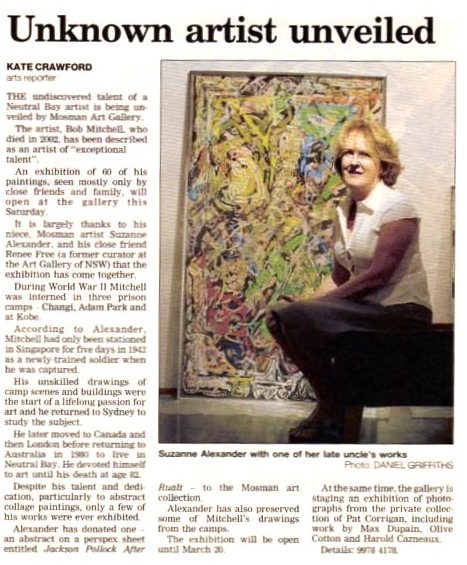
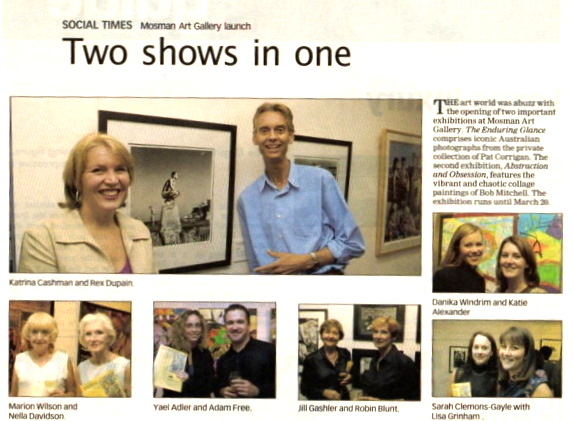
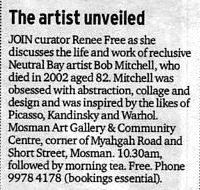
Mosman Daily, 5 February 2004: Unknown artist unveiled
"...The undiscovered talent of a Neutral Bay artist is being unveiled by Mosman Art Gallery. The artist, Bob Mitchell, who died in 2002, has been described as an artist of 'exceptional talent'. An exhibition of 60 of his paintings, seen mostly only by close friends and family, will open at the gallery.... It is largely thanks to his niece, Mosman artist Suzanne Alexander, and his close friend Renee Free (a former curator at the Art Gallery of NSW), that the exhibition has come together. ..."
Daily Telegraph, 7 February 2004:
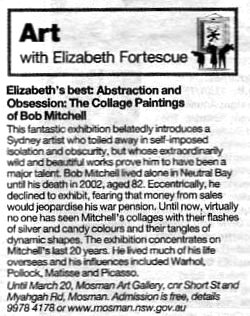
Art with Elizabeht Fortescue - Abstraction and Obsession: The Collage Paintings of Bob Mitchell
"This fantastic exhibition belatedly introduces a Sydney artist who toiled away in self-imposed isolation and obscurity, but whose extraordinarily wild and beautiful works prove him to have been a major talent. Bob Mitchell lived alone in Neutral Bay until his death in 2002, aged 82. Eccentrically, he declined to exhibit... The exhibition concentrates on Mitchell's last 20 years. He lived much of his life overseas and his influences included Warhol, Pollock, Matisse and Picasso."
Mosman Daily, 12 February 2004
Sun Herald, 15 February 2004
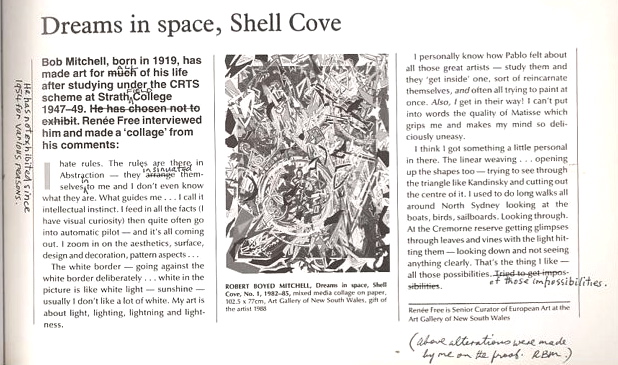
Art and Australia, Volume 27, Number 2, 1989
Shown with Robert Mitchell's own alterations.
Copyright Estate of Robert Boyed Mitchell Created by Banziger Hulme Fine Art 2007